


How to Hit Your Macros? Tracking macros can feel restrictive, especially when you want to enjoy a night out with friends. If you’ve ever found yourself at a party, sipping on water while watching everyone else indulge, you know what I mean. While it can feel overwhelming to factor alcohol into your macro tracking, the process doesn’t have to be so daunting. In this article, we’ll cover how to track alcohol macros so you can enjoy social drinking without feeling restricted while still maintaining your fitness and nutrition goals. Goldi AI’s calorie tracker makes tracking alcohol macros so easy you won’t even notice you’re doing it. The more you know about how alcohol affects your body and what different types of alcoholic beverages contain, the easier it will be to log alcohol into your macro tracking routine.
Is Alcohol a Macronutrient?
Alcohol is classified as a macronutrient. When tracking macros, alcohol is technically the shadowy “4th macro,” as it provides your body with seven calories per gram. Still, because it isn’t essential for survival, it’s not typically mentioned alongside protein, fat, and carbs. Alcohol is not a nutrient (it does not provide nutrition to your body and is, in fact, toxic at high doses).
So, it isn’t a carb, a protein, or a fat, which is why you will sometimes see it with calories but no macros when you try to log it in an app.
Alcohol Provides Energy But No Nutrition
It’s essential to keep in mind that alcohol has value as energy, but no nutritional value such as vitamins, minerals, or fiber. It’s similar to consuming “empty carbs” like gas station candy or table sugar. So how does one go about fitting alcohol into one’s macros?
Count Alcohol In Your Macros
You should count alcohol in your macros so that your calories and macros will be better aligned at the end of the day. Whether your goals are to lose, maintain, or gain weight, you need accurate calorie and macronutrient intake information to get results.
Accounting for Alcohol Calories
When you assign macro values to your alcohol, you will know how much to adjust your intake to account for the calories coming from the alcohol so that you meet your calorie target for the day. Alcohol can be assigned to carbs, fats, or both, as these targets can be more flexible than protein.
Protein should never be replaced with alcohol because protein is more important for muscle growth and satiety.
What To Do If You Want a Drink
If you tried to hit all of your macros and include alcohol as well, you’d notice that your total calorie count for the day would be higher than expected because of the calories from alcohol. For example, if you had a glass of wine with 125 calories but 0g of macros, and you hit all of my macro targets for the day, I’d end up with a calorie total of 125 calories higher than expected.
Is Alcohol A Carb Or A Fat?
Alcohol is not a carb or fat because it is not made up of glucose molecules like carbs or fatty acids like fats. It does not provide nutrients that your body can use or store. As such, the liver will prioritize alcohol metabolism to eliminate this toxin before anything else. So, even though you can count the calories from alcohol as if they are coming from carbs, or fat (or both) to manage your overall caloric intake, you should not take this to an extreme.
Alcohol Macros: Reference Sheet
Alcohol isn’t regulated by the Food & Drug Administration (FDA), but rather the Tobacco Tax and Trade Bureau, so nutrition labels are not required. If you can’t find the calorie information for an alcoholic beverage, we’ve got you covered with this reference sheet.
| Alcohol | Quantity | Calories | As Carbs | As Fat | As Both (even split) |
|---|---|---|---|---|---|
| Beer | 12 oz | 154 | 39 | 17 | 19.5C + 8.5F |
| Bloody Mary | Standard | 140 | 35 | 16 | 17.5C + 8F |
| Bourbon | 1 oz | 64 | 16 | 7 | 8C + 3.5F |
| Champagne | 4 oz | 90 | 23 | 10 | 11.5C + 5F |
| Cider | 12 oz | 175 | 44 | 19 | 22C + 9.5F |
| Daiquiri | Varies | 220 | 55 | 24 | 27.5C + 12F |
| Gin | 1 oz | 73 | 18 | 8 | 9C + 4F |
| Gin & Tonic | Standard | 190 | 48 | 21 | 24C + 10.5F |
| Hard Lemonade | 12 oz | 220 | 55 | 24 | 27.5C + 12F |
| Light Beer | 12 oz | 104 | 26 | 12 | 13C + 6F |
| Margarita | Varies | 274 | 69 | 30 | 34.5C + 15F |
| Martini | Standard | 125 | 31 | 14 | 15.5C + 7F |
| Mimosa | Varies | 100 | 25 | 11 | 12.5C + 5.5F |
| Moscow Mule | Varies | 182 | 46 | 20 | 23C + 10F |
| Pina Colada | Varies | 245 | 61 | 27 | 31.5C + 13.5F |
| Red Wine | 5 oz | 125 | 31 | 14 | 15.5C + 7F |
| Rosé | 5 oz | 102 | 26 | 11 | 13C + 5.5F |
| Rum | 1 oz | 64 | 16 | 7 | 8C + 3.5F |
| Scotch | 1 oz | 64 | 16 | 7 | 8C + 3.5F |
| Skinny Margarita | Varies | 114 | 29 | 13 | 14.5C + 6.5F |
| Tequila | 1 oz | 69 | 17 | 8 | 8.5C + 4F |
| Vodka | 1 oz | 64 | 16 | 7 | 8C + 3.5F |
| Whiskey | 1 oz | 70 | 18 | 8 | 9C + 4F |
| White Wine | 5 oz | 120 | 30 | 13 | 15C + 6.5F |
| Wine Cooler | 12 oz | 220 | 55 | 24 | 27.5C + 12F |
Remember to include values for any mixers like soda or juice.
How to Track Alcohol Macros Without Sabotaging Your Results
Step 1
Determine the total calories coming from alcohol. Check out our reference sheet, above, if there’s no label.
Step 2
Decide if you want to track it as carbs, fat, or a mixture. This is a matter of personal preference and whether you have more grams of carbs or fat to work with. To calculate macronutrients for alcohol, we need to know ONE thing: How many calories it contains. From there, we can allot the number of calories to either carbs, fats, or a combination.
For example, if your drink has 100 calories, you can track that as 25 grams of carbs, 11 grams of fats, or 13g carbs and 6g fats.
Customizing Alcohol Macro Tracking
When tracking as a combination of both, any ratio works too. As in, you don’t have to allot 50% of the calories to fats and 50% of the calories to carbs. You could do 25% fats and 75% carbs if you wanted (3g fats and 19g carbs) if that fits your macros for the day better! Is it better to track alcohol macros as carbs, fats, or a combo or carbs and fats?
Choosing Your Alcohol Tracking Method
Which option is better? Well, that will depend on your macros for the day and which option best fits into your day. It’s important to note that the route you decide to take each time may also change depending on what else you have already consumed/plan to drink that given day.
Aligning Alcohol with Your Day’s Macros
I recommend looking at your day as a whole. Is your day more carb-heavy? Is your day more fat-heavy? For example, if you have been traveling and eating out a lot, you’ve likely been consuming higher fats because restaurants use a lot of oil. So, in that case, I recommend allocating more alcohol calories to calories.
Alcohol and Daily Macro Choices
But if it’s just a typical day at home and you want to have a margarita, you may have more balanced macros and decide to allot half to carbs and the other half to fats. Okay, you just need to know the calories to track alcohol macros… Cool. But what if I don’t know how many calories are in my drink?
When Exact Calories Don’t Matter
I also want to mention that if you can’t find the exact calories for your drink of choice, don’t worry! Generally, similar types of drinks will have similar calories, and if you only drink on occasion, it doesn’t matter in the grand scheme of things! I typically do a quick Google Search, find something similar, and call it good!
Honestly, it’s not worth overthinking. Just go with what makes sense and don’t stress it. If you only drink occasionally anyway, it doesn’t matter in the grand scheme!
A Common Misconception
One of the most common questions regarding tracking alcohol calories/macros is how a drink can claim “0 g carbs” (with 0 g fat and 0 g protein) but have 100 calories? If it has 0g of everything on the nutrition label, does that not mean it has zero calories?
Understanding Alcohol’s Caloric Impact
As mentioned before, alcohol is technically the 4th macronutrient. It contains calories, but because alcohol does not provide essential macronutrients (in carbs, protein, and fat), companies can legally claim that their drink has zero carbs, zero fats, and zero proteins and put that on their label.
This is why we ALWAYS look at the actual calorie number! Be sure to always only pay attention to the calorie label and track as described above. In this case, you would figure out how to track 80 total calories (20 g carbs, 9 g fats, or 10 g of carbs and 4 grams of fat).
Step 3
Divide the total calories by 4 to get the grams of carbs or by 9 to get the grams of fat. If you want to track as a mixture of both, determine how many calories will be tracked as carbs and divide that number by 4, and the remaining calories will be divided by 9.
Use This Equation To Find Macros For Any Alcoholic Drink
This equation is helpful if you cannot figure out the total calories for an alcoholic drink you want to have by using alcohol by volume (ABV) percentage.
Imperial (Ounces)
- 1 gram / 0.0352 oz. = 28.409
- 28.409 x ___ oz. = ___ grams
- X = ___ grams x 7 calories per gram = ___ total calories
- ___ (ABV%) x ___ total calories = ___ calories per ___ oz.
- Convert calories in carbs, fat, or both.
Metric (Milliliters)
- 1 gram = 1 ml.
- X = ___ grams x 7 calories per ml. = ___ total calories.
- ___ (ABV%) x ___ total calories = ___ calories per ___ ml.
- Convert calories in carbs, fat, or both.
Important Note: ABV% is the alcohol by volume, which measures how much alcohol (ethanol) is in the amount of an alcoholic beverage.
Step 4
Log the calories and grams in your nutrition app. Apps like Cronometer have a “quick add” feature that lets you add macros and calories without searching for an entry. You can also create a custom food entry for your drink, especially if it’s a common choice.
6 Tips for Drinking Alcohol and Staying on Track
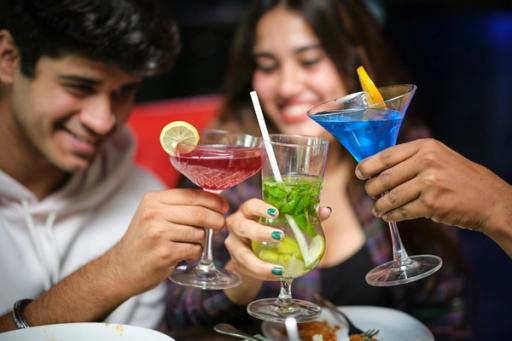
1. The Midnight Snack! Plan and Log It
If you’ve ever drunk alcohol, you know the hunger that hits after a night of drinking. Snacks after a night of drinking can derail your progress, so it’s best to plan to take control of the situation. So, pre-plan and pre-log a midnight snack for after your event or night out. This will help you feel more in control of the situation and less likely to go off track completely.
Keep it simple and do a 100-calorie popcorn or protein bar bag. Or my personal favorite… go ahead and prep yourself a macro-friendly chicken quesadilla to pull out for a late-night snack!
2. Fill Up on Wholesome Foods Before You Drink
No one wants to be the party pooper who can’t have any fun because they’re on a diet. So, if you know you’re going to be consuming alcohol, it’s best to just fill up on nutritious foods beforehand so you can enjoy yourself without completely derailing your progress. The day of the event, eat plenty of wholesome, healthy, fiber-filled foods to help you feel fuller.
I recommend always trying to hit your protein goal on days you know you’ll consume fewer carbs and fats, which will also help you feel fuller.
3. Hydrate, Hydrate, Hydrate
As you probably already know, alcohol is super dehydrating. Water makes up over two-thirds of a healthy human body, so many things are thrown off balance when dehydrated! Not to mention the fact that we are going to feel way worse the next day if we are going to bed dehydrated. Dehydration also adds to feelings of hunger, which, as discussed, is already enough of a challenge when drinking!
4. Choose Low-Calorie Mixers
When it comes to tracking alcohol macros, it’s not just the alcohol itself you need to worry about, but also the mixers. Sugary mixers can turn your “light” drink into an un-tracking nightmare. Instead of sugary options like juice or regular soda, choose low or no-calorie options like:
- Diet soda
- Sparkling water
- Seltzers
- Zevia (stevia-sweetened carbonated beverages that are similar to diet soda)
5. Budget For A Fun Snack
Since many people find that drinking alcohol puts them in the mood for a snack, leave a “buffer” of 10-15% of your calories for the day for a fun snack so you won’t feel bad about eating a few chicken wings or nachos.
6. Limit Alcohol Intake To No More Than 5-10% Of Total Calories
Overconsuming alcohol leads to negative health consequences, so it’s best to limit your intake to leave room for more nutritious calories from whole foods.
Track Your Calories within Less Than 15 Seconds with Our Calorie Tracker App
Goldi AI transforms calorie tracking with cutting-edge AI technology. Just snap a photo of your meal, and we’ll do the rest.
Our app combines your phone’s depth sensor with advanced AI models to:
- Analyze food volume
- Identify ingredients
- Instantly calculate calories, protein, carbs, and fat content.
With 90% accuracy on visible foods and multiple tracking options like:
- Barcode scanning
- Food label recognition
- Manual descriptions for complex items like smoothies
We’ve made nutrition tracking effortless. Whether scanning a full meal or a quick snack, Goldi AI
- Provides nutritional information in under 15 seconds
- Eliminates the need for tedious manual logging.
Our AI learns from your feedback to improve accuracy. It includes personalized insights and smart reminders to keep you on track. Goldi AI makes achieving your fitness goals simpler than ever.
Track your calories with your camera using Goldi AI’s calorie tracker today!